
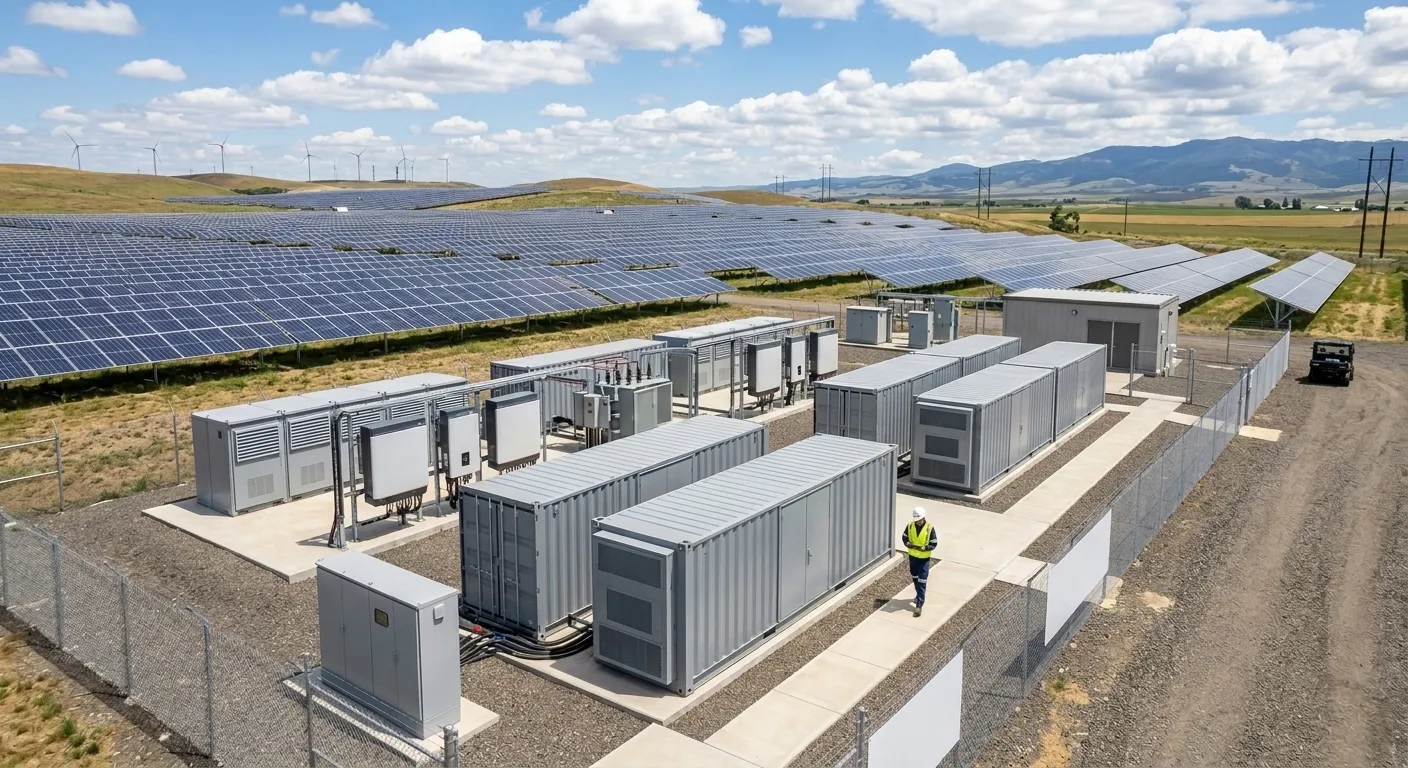
Project Polaris Phase I is a utility-scale energy storage asset designed for the high-density power corridors of North Dallas. By leveraging strategic proximity to key transmission infrastructure and high-load commercial hubs, the project aims to stabilize the local grid while capturing premium revenue through ERCOT market participation.
1. Core Technical Configuration
The project is engineered for high reliability and safety, specifically tailored to withstand extreme climate conditions while supporting the needs of nearby data centers and manufacturing campuses.
- BESS Configuration: A 60MW/240MWh system composed of 48 standard 5MWh LFP (Lithium Iron Phosphate) liquid-cooled containers. The 4-hour duration ensures coverage of evening peak pricing and provides extended backup for critical infrastructure.
- Grid-Forming Technology: Integrated Grid-Forming PCS (Power Conversion Systems) provide autonomous voltage sourcing, dynamic reactive power regulation, and system damping, effectively mitigating low short-circuit ratios in the North Dallas grid.
- Safety Engineering: The site utilizes UL 9540A-certified enclosures, dual-layered fire suppression (perfluorohexanone gas plus segmented water sprinklers), and firewall isolation to prevent thermal runaway propagation.
2. Multi-Layered Revenue Stacking Model
Project Polaris employs a three-pronged revenue strategy to ensure asset profitability throughout the year:
- Real-Time Arbitrage: Charging during low-price periods (e.g., $15-$25/MWh) and discharging during peak price events (e.g., $1000-$4000/MWh) in both summer and winter sessions.
- ERCOT Ancillary Services (ECRS): Utilizing 4-hour storage capabilities to provide 10-minute response services, capturing stable capacity payments.
- 4CP Virtual Power Plant (VPP) Management: Entering microgrid agreements with neighboring high-load facilities (data centers and semiconductor plants). By discharging during 4CP (4 Coincident Peaks) events, the project reduces partner transmission fees, with savings shared to create stable, off-balance-sheet cash flow.
3. Financial Structuring and Tax Optimization
To achieve financial efficiency, the project maximizes federal incentives and utilizes the transferability provisions of the IRA.
- ITC Maximization: The project targets a 50% total ITC, comprised of a 30% base rate (meeting wage/apprenticeship requirements), a 10% Domestic Content bonus (local PCS/battery sourcing), and a 10% Energy Community bonus (brownfield/closed mine site selection).
- Monetization Strategy: With total project investment at $95M, the $47.5M tax credit can be monetized through transferability, allowing the project to recover nearly half of its capital investment as immediate cash flow if the parent company cannot digest the credit internally.
4. Project Execution Roadmap
The project follows a disciplined 18-month timeline to reach Commercial Operation Date (COD):
| Stage | Core Tasks | Duration |
| M1-M3 | Site control & Interconnection screening | 3 months |
| M4-M9 | ERCOT FIS (Full Interconnection Study) & Compliance | 6 months |
| M10-M15 | EPC procurement, civil engineering, & construction | 6 months |
| M16-M18 | Grid-level commissioning, telemetry testing, & COD | 3 months |
Key Milestones
- Grid Readiness: Successful submission of interconnection deposits and completion of full system impact studies (short-circuit current, reactive power compensation).
- Engineering Compliance: Local municipal approvals (noise level ≤55dBA) and completion of fire safety/containment infrastructure.
- Operational Integration: ERCOT remote telemetry verification, closed-loop debugging (step response/load testing), and synchronization with AI-driven trading platforms.
Conclusion
Project Polaris Phase I is a comprehensive, highly executable utility-scale storage strategy. By integrating grid-forming technology with a tiered revenue model and aggressive financial structuring, the project provides a robust solution for the North Dallas energy landscape, ensuring financial maximum returns while enhancing the resiliency of mission-critical data center operations.